Bahawalpur
Historic city and former princely state capital in Punjab, Pakistan.

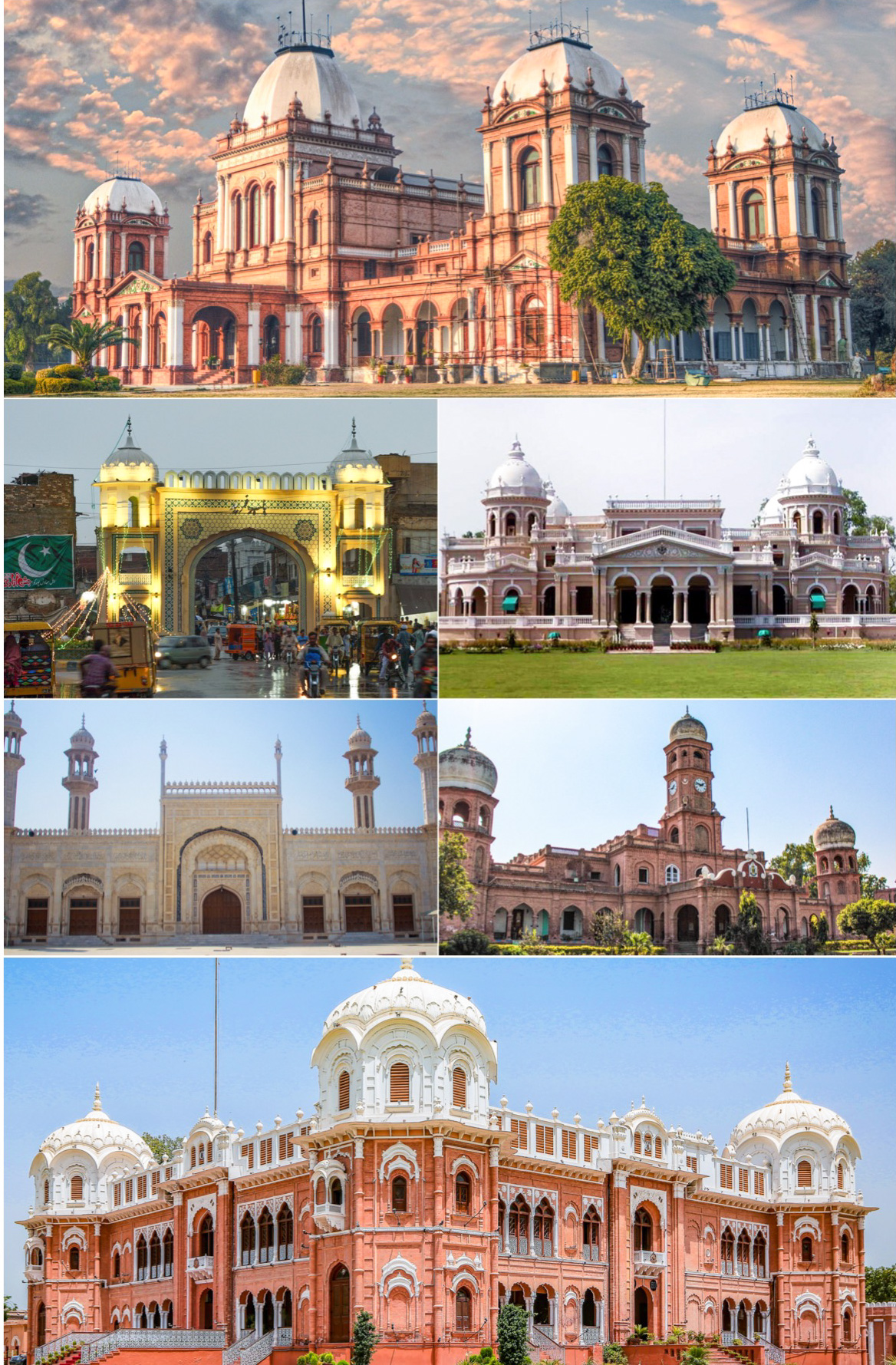
Usamashahid433; Shaviree; Tanzeel Uz Zaman Babar; Tahsin Shah; Aurungzeb; Ab bas · CC BY 2.5
The city lies at the edge of the Cholistan Desert and is the gateway to Lal Suhanra National Park.
- Country
- Pakistan
- Province
- Punjab
- Literacy Rate
- 71.67%
- Major Language
- Saraiki (59.49%)
- Climate
- Semi-arid (BSh)
Lore & Background
It replaced Derawar as the clan's capital and initially flourished as a trading post on routes between Afghanistan and central India.
Reader's Guide
Bahawalpur's significance lies in its role as the capital of a princely state that maintained autonomy through treaties with the British and later acceded to Pakistan. Its architectural monuments from the Nawab period remain a defining feature. The city's history includes ancient societies, with ruins from the Indus Valley Civilisation and Buddhist sites like Patan minara. It emerged as a centre of Chishti Sufism in the mid-18th century. Economically, Bahawalpur is known for crops such as cotton, sugarcane, wheat, and mangoes, and for industries including textiles, sugar, and vegetable ghee. The city is also famous for crafts like carpets, embroidery, and pottery. Bahawalpur's legacy includes its role as a refuge during the decline of Mughal and Sikh power, and its modern challenges include political violence and natural aridity.
Did You Know?
- Bahawalpur is the 13th most populous city of Pakistan and 8th most populous of Punjab.
Rise to Power and the Dhillon Ascendancy
Jhanda Singh Bhangi, the eldest son of Hari Singh, inherited a legacy of formidable martial power in the Punjab. Hari Singh was regarded as one of the most powerful Sikh warriors of his era, and his death opened the path for his son to assume leadership of the Bhangi Misl. Under Jhanda Singh's command, the Dhillon family rose to become the de facto ruling power across Punjab, a transformation that reshaped the political landscape of the region. He did not act alone; his younger brother Ganda Singh, himself a warrior of considerable reputation, was appointed commander in chief of the forces, creating a dual leadership structure that combined strategic oversight with battlefield command. Jhanda Singh also cultivated alliances beyond his own family, most notably with Jassa Singh Ramgarhia, who became one of his closest friends. Together, this network of kinship and friendship gave the Bhangi Misl a depth of military and political reach that few other misls could match in the mid-eighteenth century.
The 1766 Bahawalpur Standoff
They halted on the right bank of the Sutlej River, directly across from Bahawalpur. The ruler of Bahawalpur, Mubarik Khan, moved to intercept them, and Shuja Khan, the governor of Multan, joined the confrontation. What followed was a hard-fought engagement between the Sikh and Muslim forces, yet neither side could claim a decisive victory. The stalemate produced a pragmatic outcome: the two parties agreed to divide the territory between Bahawalpur and Lahore, formalizing the arrangement through a signed treaty. Pakpattan was designated as the boundary line separating the two spheres of influence. This episode established a pattern that would recur in later years—Bahawalpur's rulers repeatedly found themselves on the wrong side of Bhangi military ambitions, and the Sutlej River served as both a natural frontier and a recurring flashpoint in the rivalry between the Sikh misls and the Nawabs of Bahawalpur.
Defying Ahmad Shah Durrani
Rather than meeting the Afghans in a single set-piece battle, the three leaders opted for a strategy of relentless guerrilla harassment, striking Durrani's columns from multiple directions and refusing to commit to a decisive engagement. The Sikhs dismissed the overture entirely and pressed their attacks without pause. Jhanda Singh then turned his attention to consolidation. Stationed in Amritsar, he completed the fort that his father Hari Singh had initially begun and laid out the city's infrastructure, cementing Sikh control over the heart of the region.
The 1771–1772 Bahawalpur and Multan Campaigns
The Nawab responded by sending his nephew Jafar Khan with a select force across the Sutlej. The battle was brutal; several of the Nawab's officers fell, and Majha Singh himself was killed by a bullet. Yet his men refused to break. Faced with the prospect of further losses, the Nawab purchased peace by paying one lakh rupees. The following year brought a more complex confrontation. After the ineffective governorship of Haji Sharif Khan in Multan, Shuja Khan—backed by Jafar Khan of Bahawalpur—besieged the city. Sharif Beg Taklu, the new governor, appealed to Jhanda Singh and Ganda Singh for aid. Ganda Singh, passing through Bahawalpur, extracted another lakh of rupees in tribute.
Gallery
Frequently Asked Questions
What is Bahawalpur?
Bahawalpur is a historic city in Punjab, Pakistan, perched at the edge of the Cholistan Desert. It once served as the capital of a princely state before the modern era reshaped the region's political boundaries.
What makes Bahawalpur geographically notable?
The city is best known as the gateway to Lal Suhanra National Park, a vast protected green zone that stands out in an otherwise arid landscape. Its semi-arid (BSh) climate and desert-fringe location give it a character quite distinct from other Punjab cities.
What language dominates in Bahawalpur?
Saraiki is the primary local tongue, spoken by roughly 59 percent of residents. The city's literacy rate hovers around 71.67 percent, reflecting ongoing educational development in the area.
What is Bahawalpur's climate like?
Bahawalpur sits in a semi-arid zone, meaning scorching summers, mild winters, and very limited annual rainfall. The Köppen classification for the area is BSh, underscoring how much the surrounding desert influences daily life.
Why is Bahawalpur historically important?
As the former seat of a princely state, Bahawalpur carried significant administrative, cultural, and political weight in Punjab well before and after the 1947 partition. That royal heritage still shapes the city's identity and distinguishes it from neighboring towns.
More in Miscellaneous Cities 1-22
Spotted an error? Know more?
This is a living reference — every entry is fact-audited, and reader corrections feed straight into our audit queue. Suggest an edit · See this site's audit record